


Thursday September 10, 2026 - Interest of Justice
One minister banned a political party in May with no hearing, no conviction and no court review. The Act says so in its own headings. Judgment is reserved. Germany makes a court decide who gets banned. Australia lets a politician sign a paper.
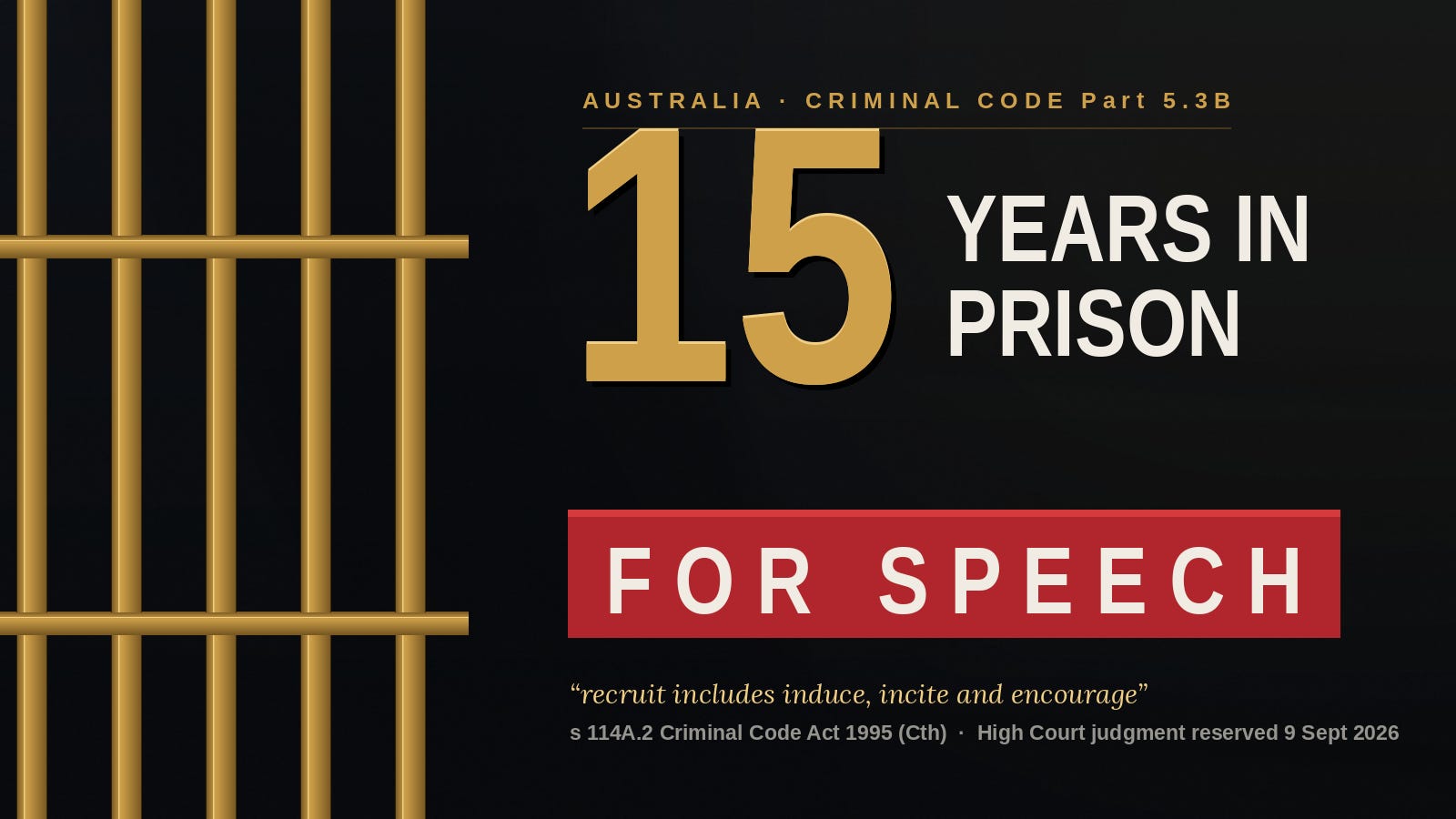
Right now in Canberra, seven judges are deciding whether one politician can outlaw a political party by signing a piece of paper.
That’s the whole case and it’s really important to free speech. Sadly it’s not being widely publicized like it should be.
The threat is very real because we're talking about 15 years in prison based on speech that someone doesn't like, and the law apparently would apply to Australians no matter where they were in the world. That's pretty draconian, so let's get into it.
On Tuesday and Wednesday the High Court of Australia heard White Australia Party Inc & Anor v Commonwealth, case M50/2026. Chief Justice Gageler sat with the Full Court. Judgment is reserved, which means they went away to think and nobody knows when they come back. Weeks. Maybe months.
One important clarification — there is no testimony in this case and there never was. It's a "special case," which means both sides agreed the facts in writing and the Court only hears legal argument from barristers. No witnesses, no evidence, nobody on a stand.
Let’s put the ugly part first so nobody has to wonder where IoJ stands. The group that brought this case is a neo-Nazi outfit run by a man with criminal convictions, and I’ve got no use for them. Evelyn Beatrice Hall wrote the line everybody hands to Voltaire — “I disapprove of what you say, but IoJ will defend to the death your right to say it.” She was describing a principle, and a principle doesn’t get to pick who walks through the door with it. Bad laws almost always show up strapped to somebody nobody wants to defend. That’s how they get through.
So let’s look at the law instead of the plaintiff.
Speech gets a group banned, then speech about the group sends you to prison
In January, weeks after the Bondi Beach attack, Australia’s Parliament passed the Combatting Antisemitism, Hate and Extremism (Criminal and Migration Laws) Act 2026. It bolted a new Part 5.3B onto the Criminal Code.
Here’s the machine, in plain words.
A minister decides a group is a PROHIBITED HATE GROUP and the Governor-General signs the regulation.
He acts on advice from ASIO, the domestic spy service, and the Attorney-General.
He can list a group for having ADVOCATED hate crimes, and section 114A.2 says advocating includes PRAISING them.
He can list it for advocacy that happened “whether or not in Australia.” Words spoken anywhere on earth will do.
Section 114A.4(4) is headed CONVICTION NOT REQUIRED.
Section 114A.4(5) is headed NO PROCEDURAL FAIRNESS REQUIRED.
Read that last one twice. Parliament typed it as a heading. The law doesn’t quietly leave the hearing out, it announces there won’t be one.
“The AFP Minister is not required to observe any requirements of procedural fairness.”
— Criminal Code Act 1995 (Cth), s 114A.4(5)
Then the sentences start, and every offence but one comes in two tiers. You get the high number if you knew the group was listed. You get the low number if you were merely careless about whether it was.
Directing the group — 15 years if you knew, 10 if you were reckless.
RECRUITING for it — 15 years, and section 114A.2 defines recruit to “include induce, incite and encourage.” Encouraging one person is a conversation.
Training with it — 15 years, and the element that the group is even listed carries STRICT LIABILITY.
Getting funds to it or from it — 15 years if you knew, 10 if you were reckless.
Providing support or resources — 15 years if you knew, 10 if you were reckless.
Being a member — 7 years. If you want the defence that you quit the moment you found out, you have to prove it yourself.
The only defences in the entire division are doing something under a Commonwealth agreement or performing an official duty. There’s no fair comment defence. Nothing for journalists. Nothing for scholars. Nothing for anyone quoting the group to criticize it.
So follow the chain all the way through. A group can be listed for what it said, including mere praise, including words spoken overseas, with nobody convicted of anything and no hearing held anywhere. After that, encouraging one single person toward that group carries fifteen years.
In May, Home Affairs Minister Tony Burke used it and listed White Australia. The group had been trying to register as a federal party and told the Electoral Commission it had 1,779 members, just over the 1,500 the law requires. The party attempt and the ban landed in the same month.
A UN human rights officer warned them in writing, before it passed
Ben Saul is the United Nations Special Rapporteur on human rights while countering terrorism. On January 15 he filed a submission with the parliamentary committee reviewing the bill.
He counted the days out loud. The public got THREE DAYS to comment on 144 pages of legislation and a 319-page explanatory memorandum, scheduled during the summer break when Australian lawyers are away.
“It is the experience of the Special Rapporteur’s mandate worldwide that hasty lawmaking is prone to lead to over-reach, unintended consequences, and violations of human rights law.”
— Ben Saul, UN Special Rapporteur, 15 January 2026
He listed what was missing. No requirement that a group be regularly involved in anything, since a single incident will do. No proportionality test weighing the harm against banning every person in the group. No procedural fairness. He warned that words like “advocates” and “praises” are too vague to carry criminal weight and get abused everywhere they’re tried. His fix ran one sentence. Put the power to ban a group in a court, not a minister.
Parliament passed it anyway, and it took effect on 22 January.
Australians have no right to free speech, and most of them don’t know it
This is the part that stops Americans cold.
Australia has no bill of rights. There’s no First Amendment to reach for. What Australians have is an IMPLIED FREEDOM OF POLITICAL COMMUNICATION that the High Court found buried inside sections 7 and 24 of their Constitution, the parts saying senators and members must be “directly chosen by the people.” The court’s reasoning was simple, because you can’t choose anybody if you’re not allowed to talk about them. Lange v ABC (1997) built the test, and McCloy (2015) and Brown v Tasmania (2017) sharpened it.
And it still isn’t a right. It’s a limit on what Parliament can pass. No Australian walks into a courtroom and says the government violated my free speech. The only thing anyone can argue is that Parliament never had the power to write the law in the first place.
That’s a thin thread, and Part 5.3B is hanging off it.
Now look at how other countries do this.
Germany has more reason than any country on earth to ban a Nazi party, and it can. Article 21(2) of its Basic Law says so. But only the Federal Constitutional Court is allowed to do it, never a minister and never a cabinet. In 2017 that court refused to ban the far-right NPD, and the reason lands right on this case. The party was too small and too weak to actually threaten the constitutional order, so a ban wasn’t warranted. The size and the real-world reach of the group were part of the legal test.
The United States settled this during its own Red Scare. In United States v. Robel (1967) the Supreme Court struck down a law barring Communist Party members from defense jobs because it punished membership by itself. Scales v. United States (1961) held that mere membership isn’t enough, since you need active membership plus intent. Brandenburg v. Ohio (1969) drew the line still standing today, and speech can’t be punished unless it’s aimed at producing imminent lawless action and likely to actually produce it. NAACP v. Alabama (1958) protected the right to associate at all, in a case brought by people the state of Alabama very much wanted to name.
Europe permits party bans under Articles 10 and 11 of the European Convention, and the Strasbourg court upheld one in Refah Partisi v Turkey (2003). A constitutional court ordered it. Then a second court reviewed it.
Australia stands alone here. One minister, one signature, no hearing, no review.
There’s one more case, and everyone in that courtroom was thinking about it. In 1951 Robert Menzies tried to dissolve the Communist Party of Australia by statute. The government wrote the emergency into the law’s own preamble and argued that settled the question. In Australian Communist Party v Commonwealth (1951) 83 CLR 1 the High Court struck it down, and Justice Dixon’s answer became the most quoted line in Australian constitutional law — a stream cannot rise higher than its source. Parliament can’t hand itself a power by writing down that it has one.
Constitutional scholar Anne Twomey, writing in Crikey the morning the hearing opened, put the question better than anyone in the room.
“Should the federal government be constitutionally able to ban a group, resulting in stiff criminal penalties for its continuing members, even though the group has not committed any crime?”
— Professor Anne Twomey
She told the ABC the laws were rushed through without sufficient scrutiny, and that the real danger was never this group.
“Theoretically, [future governments] could use this kind of legislation as a way of preventing opposition.”
The Commonwealth’s barrister, Brendan Lim, conceded on Wednesday that the law burdens political communication. His argument is that the burden is worth paying. Six state Attorneys-General filed to back him, from New South Wales, Victoria, Queensland, Western Australia, South Australia and Tasmania. Every one of them.
Maybe the court agrees with all seven of those governments. Think about what that means if it does. A minister decides which political groups are allowed to exist. He needs no conviction, holds no hearing, and never has to explain himself to anybody. The next minister inherits that power. So does the one after him, and the one after that, and not one of them has to be as trustworthy as whoever holds it today.
Australia has no written free speech right to fall back on when that day comes. Neither will anyone else, in any country that copies this, once the last court that could have said no decides not to.
Judgment is coming for better or for worse. We all need to watch Canberra & this case.
What happens next, and where to watch
No ruling date exists. Australian constitutional judgments typically land weeks to months after argument. The Court gives no advance notice of the handing-down date beyond a short public listing.
Every filing is free and public on the case page — the plaintiffs’ and defendants’ written submissions, the Special Case, both days’ outlines of oral argument, all six state Attorneys-General submissions, and the Free Speech Union’s application to intervene as amicus curiae. There’s also a downloadable case summary.
The transcript of both hearing days is published free on AustLII’s High Court transcript database and on Jade. The Court posts transcripts the day after it rises, so both days should be up now.
Let humanity keep free speech alive forever!
Lady Xylie - IoJ

Related reading
Trump Signs Executive Order On "Domestic Terrorists" - As Palantir Delivers Total Surveillance System To US
Trump Signs Executive Order On “Domestic Terrorists” - As Palantir Delivers Total Surveillance System To US
INFORMATION CONTROL - The Systematic Suppression of Truth as a Violation of Fundamental Human Rights

PART I, THE LEGAL FOUNDATION—Why Information Suppression Is Not a Peripheral Concern
ENDS TODAY: US Request for Public Comments Regarding Technology Platform Censorship

Some of you readers may want to take quick action on this last minute opportunity to comment to the US Government - so this one is for the active activists.

The WHO vouched for the COVID-19 shots, and countries took its word. We allege the WHO's emergency listings were commercial conduct, which its immunity doesn't cover. IoJ is raising the fund to take that case to U.S. federal court, where the law's commercial-activity exception means the WHO's immunity does not apply.
Interest of Justice Media Inc is a 501(c)(3) nonprofit, EIN 99-2410252. Gifts are tax-deductible as allowed by law. Checks, donor-advised funds and partnerships: interestofjustice.org/donate · media@interestofjustice.org
Thanks for shining the light about this!! Extremely disturbing - Australians need to really stand up about this.
We must not comply to their draconian measures against us all. UN Article 19 states we have a right to free speech and freedom of expression , it's also a god given right .