
We've Got Them On Judicial Record Violating Nuremberg! Accountability Won't Legally Happen Like We Think..Nuremberg Code Is Based On Ethics And Enforcement Is Not Like 1945... It's Different!
Understanding the strategic legal reality—and November To Remember!

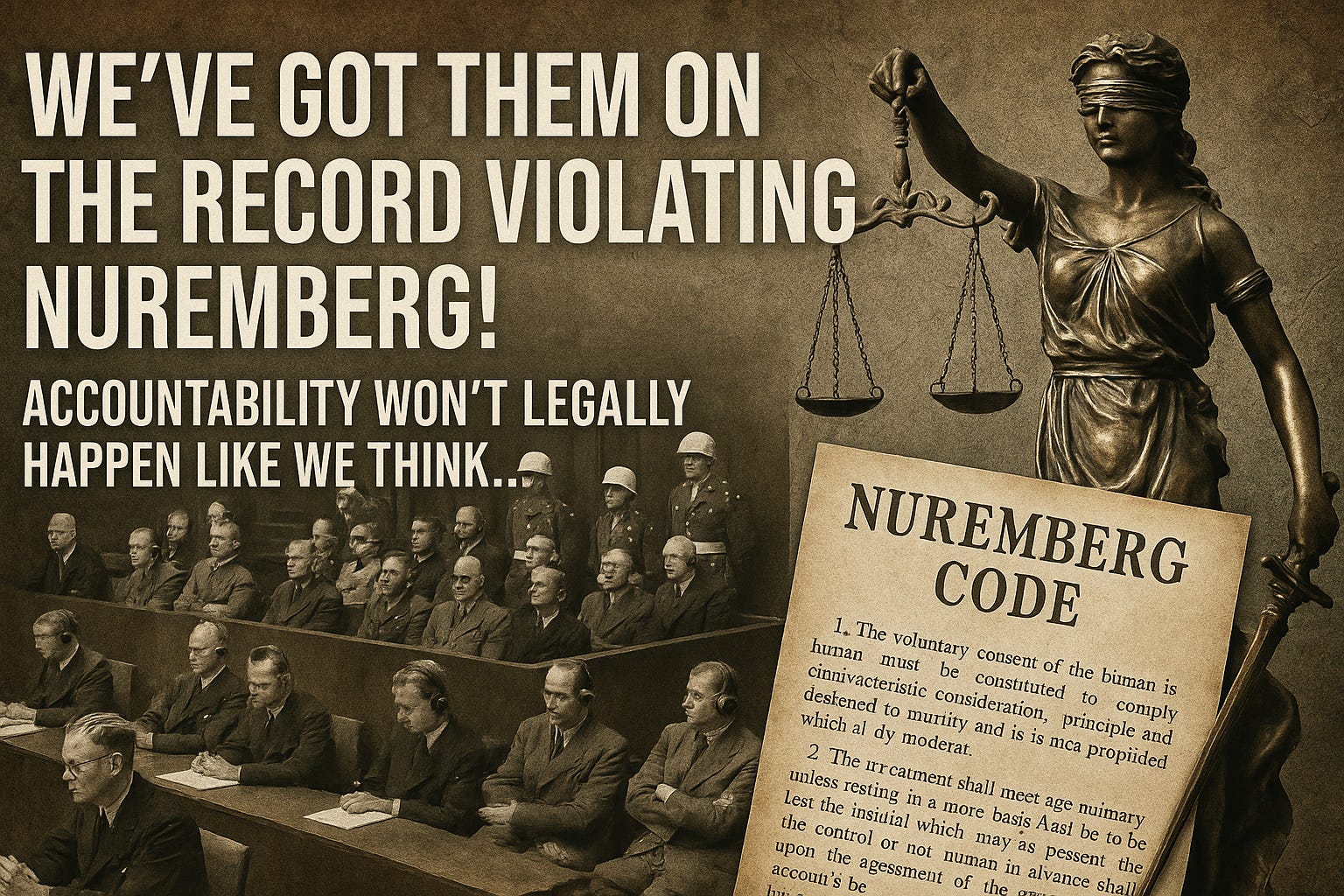
Many people picture the same thing when they hear “Nuremberg trials.” Dramatic courtroom. War criminals in the dock. Swift justice delivered in a single, cinematically satisfying proceeding. It’s become cultural shorthand for accountability after mass atrocity.
But if we’re being honest about what accountability looks like in 2025—particularly for pandemic-era violations of the Nuremberg Code’s most fundamental principle of informed consent—we need to talk honestly about the legal architecture we’re actually working within.
Because here’s what needs to be said clearly: there isn’t going to be one big trial. And understanding why reveals everything about how real accountability actually works in the modern international legal system.

The Nuremberg Code established that “the voluntary consent of the human subject is absolutely essential” for any medical experiment. Article 7 of the International Covenant on Civil and Political Rights reinforced this prohibition against medical experimentation without free consent. These weren’t aspirational suggestions—they were supposed to be binding legal constraints on state power after the world witnessed what happens when medicine becomes weaponized by authoritarian regimes.
But here’s the problem that’s plagued international law since 1947: principles without enforcement mechanisms remain exactly that—principles. Words that governments cite in peacetime and violate during “emergencies.”
What we’re building at Interest of Justice is the enforcement infrastructure those ethical principles never had. Not through revolutionary upheaval or extrajudicial tribunals, but through strategic litigation within existing legal systems. Constitutional challenges. Administrative complaints. International court filings. Diplomatic pressure. Building precedent one jurisdiction at a time.
It’s methodical work that doesn’t generate viral headlines. But it’s how you actually constrain institutional power through law.
Why IoJ thinks that the 1945 Model Cannot Be Replicated, but definitely enforced!
The original Nuremberg trials occurred under extraordinary circumstances that cannot be reproduced. Total military defeat of the Axis powers meant the Allied forces controlled territory, held defendants in custody, and possessed the sovereign authority to create an international military tribunal with actual enforcement power. The legal framework was established by victorious nations with the military capacity to execute judgments.
That was a unique historical convergence of military victory and moral clarity that simply doesn’t exist in 2025.
Contemporary violations of medical ethics and human rights have emerged from a deliberately decentralized global governance structure. The WHO operates under international treaties that provide institutional immunity while allowing it to issue “guidance” and “recommendations” that member states implement as binding policy. Pharmaceutical corporations maintain different liability protections in each jurisdiction—protections they actively lobbied for through regulatory capture. National governments mandate medical interventions while claiming they merely followed international scientific consensus.
This architecture was designed, whether intentionally or through institutional evolution, to diffuse responsibility and complicate accountability.
There is no single international court with universal jurisdiction over pandemic-era human rights violations. The International Criminal Court has limited jurisdiction and requires state cooperation. The International Court of Justice adjudicates disputes between nations, not violations within them. Each country’s constitutional framework governs how its government can be challenged for rights violations.
What this means practically? Example, violations that occurred in Costa Rica require remedies under Costa Rican constitutional law. Mandates imposed in Austria must be challenged in Austrian courts under Austrian legal principles. Canadian Charter violations demand Canadian litigation. American constitutional injuries require American legal action.
The International Health Regulations (2005) created obligations for WHO member states, but enforcement mechanisms remain tied to national sovereignty. When the WHO declared a Public Health Emergency of International Concern—a declaration that triggered unprecedented restrictions on movement, commerce, and bodily autonomy worldwide—it did so under a framework that lacks meaningful accountability mechanisms for erroneous or fraudulent declarations.
This isn’t a flaw we can work around. It’s the jurisdictional reality we must work within.
What Interest of Justice has been doing—what we’ve been building for years now—is creating the evidentiary foundation and legal precedents that enable accountability within this fragmented system.

When we secured landmark rulings from Costa Rica’s Constitutional Chamber compelling government officials to admit under judicial examination that COVID-19 vaccines were experimental in nature, that safety and efficacy representations exceeded available evidence, and that Costa Rica’s regulatory decisions relied entirely on WHO/FDA/EMA assurances without independent verification—we accomplished something beyond a national legal victory.
We created binding judicial findings in the official record of a sovereign nation. These admissions can now be cited as persuasive authority in other jurisdictions. When advocates in other countries argue that their governments made similar regulatory decisions based on inadequate evidence, they can point to sworn government testimony from Costa Rica acknowledging this exact problem.
That’s how you build infrastructure for transnational accountability without a transnational court.
The Nuremberg hearings we conducted created formal evidentiary records featuring expert scientific testimony on regulatory processes, safety signal analysis, and the systematic suppression of dissenting scientific voices. These aren’t educational events—they’re creating citation-ready expert testimony that can be submitted as evidence in legal proceedings worldwide. When courts need expert analysis of specific regulatory failures or documentation of how safety data was manipulated, we’ve built that evidentiary foundation.
Every strategic legal filing, every motion demanding document disclosure, every properly preserved piece of evidence showing coordination between regulatory agencies and pharmaceutical manufacturers—it accumulates into a comprehensive record that makes future cases stronger.
This November 2025, Interest of Justice launches “The November to Remember”—a coordinated campaign representing years of strategic preparation.
This is not a single filing or a single legal action. It’s a synchronized effort leveraging the evidentiary foundation we’ve been building, the precedents we’ve established, and the international coordination networks we’ve developed. It’s about forcing institutional accountability across multiple venues simultaneously, making it impossible for captured institutions to ignore the mounting legal pressure.
The strategic objectives are securing formal legal recognition that mRNA products constitute experimental medical interventions that were deployed without proper informed consent in violation of established international law principles. Establishing evidentiary records of regulatory fraud sufficient to support criminal liability investigations. Creating legal precedents that constrain future attempts to suspend fundamental rights through emergency declarations.
This won’t resolve quickly. Some actions will succeed in months. Others will require years of appellate litigation. Some will establish precedents enabling subsequent cases. All are necessary components of comprehensive accountability.
This is what enforcement looks like when challenging global institutions operating across multiple jurisdictions—it’s comprehensive, coordinated, and requires sustained effort over time.
Competing against the resources of big Pharma requires strategic sophistication, not emotional reaction. It requires building cases that meet evidentiary standards, follow proper procedure, and present legal arguments that judges must take seriously under existing jurisprudence. It requires the patience to let cases develop properly rather than rushing to create media moments that accomplish nothing legally.
We understand people want immediate consequences. When you’ve witnessed healthcare workers terminated for declining experimental medical interventions, when we all seen credentialed scientists systematically censored for questioning official narratives, when you’ve watched governments violate their own constitutional protections for bodily autonomy—the desire for swift justice is entirely understandable.
But procedurally deficient cases get dismissed. Poorly documented evidence gets excluded. Legal arguments that ignore jurisdictional limitations get rejected. The only accountability that matters—the kind that actually constrains future institutional overreach—emerges from cases constructed carefully enough to survive determined opposition from institutions with unlimited legal budgets.
The implications of this legal campaign extend far beyond COVID-19 vaccine mandates. If supranational organizations and their member states escape accountability for suspending fundamental human rights through emergency declarations, we establish dangerous precedent that such suspensions can occur whenever politically convenient.
The WHO’s proposed pandemic treaty and amended International Health Regulations would codify this framework, granting the organization unprecedented authority to override national sovereignty and individual rights during future health emergencies that it alone defines. That’s why building comprehensive legal accountability now matters—it establishes guardrails that constrain future institutional overreach.
We’re not pursuing revenge. We’re establishing through law that certain ethical boundaries cannot be transgressed without consequences—regardless of emergency declarations, regardless of institutional authority, regardless of how many credentialed experts provide scientific cover for rights violations.
Years of methodical preparation are about to become visible. The November to Remember campaign launches a coordinated effort that leverages everything we’ve built.
Thank you for being here with us. Thank you for understanding that building cases capable of winning against the most powerful institutions in the world requires time, resources, and sustained commitment to legal procedure. Thank you for your patience when others demanded theatrical gestures that would accomplish nothing. Thank you for recognizing that accountability—the kind that actually changes institutional behavior—accumulates through properly constructed legal arguments, well-documented evidence, strategic coordination across jurisdictions, and the determination of advocates who refuse to let these violations disappear into historical amnesia.
The road to enforcing Nuremberg Code principles in the modern era is long, and we’re still walking it. But we’re walking it correctly, with legal sophistication and strategic patience. And November 11th marks an important acceleration of that journey.
This is what years of strategic preparation looks like when it begins to move.
NOVEMBER TO REMEMBER!
Why be the resistance, when you can BE THE PERSISTENCE!

Interest of Justice is a 501(c)(3) nonprofit organization dedicated to legal accountability and human rights enforcement. Follow the November to Remember campaign at nurembergheaing.org